Traditional CCTV vs AI Surveillance: What’s the Difference?
Compare traditional CCTV and AI surveillance to understand differences in monitoring, alerts, investigations and operational intelligence.
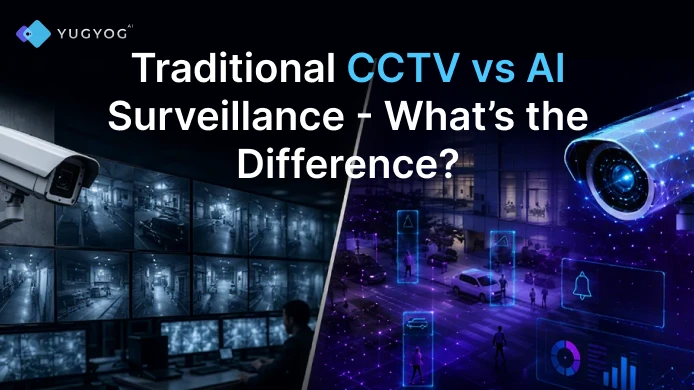
For decades, CCTV has been the backbone of physical security. Organisations have relied on surveillance cameras to deter theft, monitor facilities, investigate incidents and provide evidence when something goes wrong.That approach still works. However, the role of surveillance is changing.
Today, organisations generate enormous amounts of video across manufacturing plants, warehouses, retail stores, hospitals, schools and corporate facilities. Security teams are expected to monitor multiple locations, respond to incidents quickly, improve workplace safety and investigate events efficiently.
Simply recording video is no longer enough.
This shift has led to the adoption of AI surveillance and AI video analytics not as a replacement for CCTV, but as an intelligence layer that can transform existing cameras into systems capable of detecting, understanding and responding to events.
If you are evaluating a modern video intelligence platform, understanding the difference between traditional CCTV and AI surveillance is an important first step.
Traditional CCTV: Built for Recording
Traditional CCTV systems were designed with one primary objective: recording and storing video footage.
Whether installed in a warehouse, manufacturing plant, retail store, hospital or office, the basic workflow remains largely unchanged:
- Cameras continuously record.
- Footage is stored on DVRs, NVRs or video management systems.
- Security personnel monitor live feeds where possible.
- Investigations begin after an incident occurs.
This approach has served organisations well because it creates a permanent visual record of events.
The challenge is that surveillance networks have become much larger, while the amount of footage generated has increased significantly.
That makes monitoring and investigation increasingly dependent on human attention.
The Biggest Limitation Isn’t the Camera
Imagine a manufacturing facility operating hundreds of CCTV cameras across multiple areas.Even with an experienced security team, it is impossible for someone to watch every camera continuously and identify every unusual event.Most recorded footage contains nothing unusual.
The important moments a person entering a restricted area, a vehicle stopping unexpectedly, smoke appearing inside a facility or a worker entering an unsafe zone may last only a few seconds.
The challenge is not collecting video.
The challenge is finding those few seconds when they matter most.
Traditional CCTV therefore remains largely reactive. The footage exists, but someone has to know what to look for, where to look and when to look.
AI Surveillance: From Recording to Understanding
AI surveillance builds on existing CCTV infrastructure by adding an intelligence layer to video feeds.
Instead of simply storing footage, intelligent video analytics can continuously analyse video using computer vision and machine learning to identify people, vehicles, objects, activities and predefined events.
For a deeper explanation, read our guide to AI video analytics, which explains how organisations can turn CCTV footage into actionable intelligence. AI video analytics
Instead of asking:
“Can we find what happened yesterday?”
Organisations can ask:
“Can we know when something important happens?”
That represents a fundamental shift from passive recording to active monitoring.
Traditional CCTV vs AI Surveillance
The difference becomes clearer when the two approaches are compared side by side.
The fundamental difference between these approaches lies in how video is utilised. Traditional CCTV is primarily designed for recording and storing footage, making it a reactive tool that relies heavily on human-led monitoring and manual review after an incident occurs. In contrast, AI surveillance transforms this passive process into an active intelligence layer.
By providing automated analysis and real-time detection of predefined events, AI systems enable a proactive security posture. Furthermore, the introduction of intelligent, natural-language search capabilities significantly reduces investigation time, while the ability to generate operational intelligence beyond simple security monitoring provides broader business value all while enhancing and modernising an organisation's existing camera infrastructure.
Recording vs Understanding
Traditional CCTV records everything equally.Whether someone walks through an entrance, a delivery vehicle arrives or nothing happens for several hours, the footage is stored without necessarily understanding what is happening.
AI surveillance works differently.Using computer vision, intelligent systems can identify people, vehicles, objects, activities and events while distinguishing between routine activity and situations that require attention.Instead of merely storing footage, the system can generate actionable information from it.
Human Monitoring vs Automated Detection
Traditional CCTV relies heavily on security operators.Someone must continuously monitor live feeds or manually review recordings after an incident.
AI surveillance can continuously analyse connected camera feeds and detect events such as:
- Intrusion
- Restricted-area access
- Line crossing
- Loitering
- PPE violations
- Fire
- Smoke
- Falls
- Occupancy changes
- Vehicle activity
For example, event intelligence can identify predefined incidents and help security teams receive relevant information without requiring someone to watch every screen continuously.
The goal is not to replace security personnel.It is to help them spend more time responding to incidents and less time searching for them.
Reactive Security vs Proactive Response
Traditional CCTV is primarily reactive. An incident occurs first.The investigation begins afterwards.With intelligent surveillance, organisations can detect certain events while they are happening and trigger a response.
For example:
- Someone enters a restricted area.
- Smoke appears inside a warehouse.
- A worker enters an area without the required PPE.
- A vehicle enters a prohibited zone.
The system can identify the event and send an alert to the appropriate team.
YugYog's real-time alerts help organisations surface relevant events rather than relying solely on continuous manual monitoring.
Manual Investigations vs Intelligent Search
One of the biggest challenges with conventional CCTV is finding the right footage.
Investigators typically need to know:
- Which camera captured the event
- The approximate time
- The relevant location
- What they are looking for
They then manually review recordings.
With forensic search, investigators can search indexed footage using descriptions of the event they remember.
For example:
- “Person fallen”
- “White truck entering the gate”
- “Person loitering near entrance”
- “Vehicle parked outside loading dock”
- “Person without a helmet”
Instead of manually scrubbing through multiple timelines, investigators can locate relevant footage much faster.
This can be particularly valuable when an organisation operates multiple cameras or facilities.
Security Monitoring vs Operational Intelligence
Traditional CCTV primarily supports physical security, but modern video intelligence can extend beyond security to provide operational visibility across various industries.
In manufacturing, while traditional CCTV records incidents, intelligent video analytics enhances operations by monitoring PPE compliance, restricted areas, worker safety, and general event detection. Similarly, in retail, traditional systems are used to review theft or incidents; however, intelligent analytics offers more advanced capabilities like occupancy tracking, queue management, monitoring customer movement, and proactive event detection.
Healthcare environments shift from simply reviewing past incidents with traditional CCTV to utilizing intelligent analytics for fall detection, restricted area alerts, and real-time safety monitoring. In warehousing, the focus moves from basic recording of vehicles and loading docks to analyzing vehicle activity, optimizing loading dock management, ensuring safety, and monitoring overall workflow.
For education, traditional CCTV is limited to reviewing past security incidents, whereas intelligent analytics actively supports campus safety through intrusion detection and visitor monitoring. Finally, in corporate settings, traditional general surveillance is elevated by intelligent analytics, which provides improved security, workplace safety, and broader operational visibility.
This allows surveillance footage to become a source of operational intelligence rather than simply an archive of recordings.
Why Organisations Aren’t Replacing Their Cameras
One of the biggest misconceptions about AI surveillance is that organisations need to replace their existing CCTV infrastructure.
In many deployments, that is not necessary.Existing IP cameras, DVRs, NVRs and RTSP streams can continue operating while intelligent software adds analytics and automation on top.
YugYog's camera integration capabilities are designed around existing surveillance infrastructure, allowing organisations to connect compatible cameras without replacing their entire camera network.
The broader market is also moving towards greater use of video intelligence.
According to Grand View Research, the global video surveillance market was valued at USD 73.33 billion in 2024 and is projected to reach USD 145.38 billion by 2030, representing a 12.1% CAGR.
Similarly, Fortune Business Insights projects the global video analytics market to grow from USD 8.66 billion in 2024 to USD 33.06 billion by 2032.
The broader direction is clear: organisations are looking for more intelligence from their surveillance infrastructure, not simply more recorded footage.
What Should Organisations Look for in an AI Surveillance Platform?
The decision is not necessarily between CCTV and AI surveillance.Most organisations will continue using cameras.The more important question is whether those cameras can become a source of useful, searchable and actionable information.
When evaluating an intelligent video platform, consider:
- Can it integrate with existing CCTV infrastructure?
- Does it support IP cameras, DVRs, NVRs or RTSP streams?
- Can users search footage using natural-language descriptions?
- Can it detect predefined events automatically?
- Does it provide real-time alerts?
- Can it support multiple locations?
- Does it work across different deployment environments?
- Can it support both security and operational use cases?
- Can it help reduce investigation time?
- Does it provide appropriate security and audit controls?
These factors can have a greater impact on long-term value than simply adding more cameras.
How YugYog Fits In
Many organisations have already invested significantly in CCTV infrastructure.Replacing hundreds or thousands of cameras simply to introduce intelligent analytics may not be practical.
YugYog takes a different approach.
Instead of replacing existing surveillance infrastructure, YugYog adds an intelligence layer that can work with existing camera feeds and turn video into searchable events, alerts and operational information.
YugYog's platform brings together capabilities including:
- AI video analysis
- Camera integration
- Event intelligence
- Forensic search
- Real-time alerts
- Operational reporting
- Multi-location visibility
- Security and audit controls
The platform can connect to existing camera infrastructure and analyse video to identify meaningful events.
With real-time alerts, teams can be notified when relevant incidents occur rather than relying solely on continuous manual monitoring.
With forensic search, investigators can search indexed footage and locate relevant moments more efficiently.
YugYog's security capabilities also help organisations build intelligent surveillance workflows around their existing infrastructure.
This changes the role of CCTV from a passive recording system into an active intelligence layer.
From More Cameras to Smarter Cameras
Traditional CCTV transformed physical security by making it possible to record what happened. AI surveillance changes what organisations can do with those recordings.
Instead of relying entirely on manual monitoring and lengthy investigations, organisations can use intelligent video analytics to identify events, generate alerts, search footage and support faster responses.
The biggest opportunity is therefore not necessarily installing more cameras.It is getting more value from the cameras an organisation already owns.
Modernising Your Existing CCTV Infrastructure
Existing cameras already capture a significant amount of information every day.
The challenge is turning that video into something security and operations teams can actually use. YugYog helps organisations add intelligence to existing surveillance infrastructure so teams can detect events, investigate footage and respond to incidents more efficiently.
If you are evaluating ways to modernise your surveillance infrastructure, contact the YugYog team to discuss your requirements.