What Does Real-Time Detection Actually Mean for Camera Systems?
Understand how real-time detection identifies incidents instantly, improving safety, security and operational response with existing CCTV.
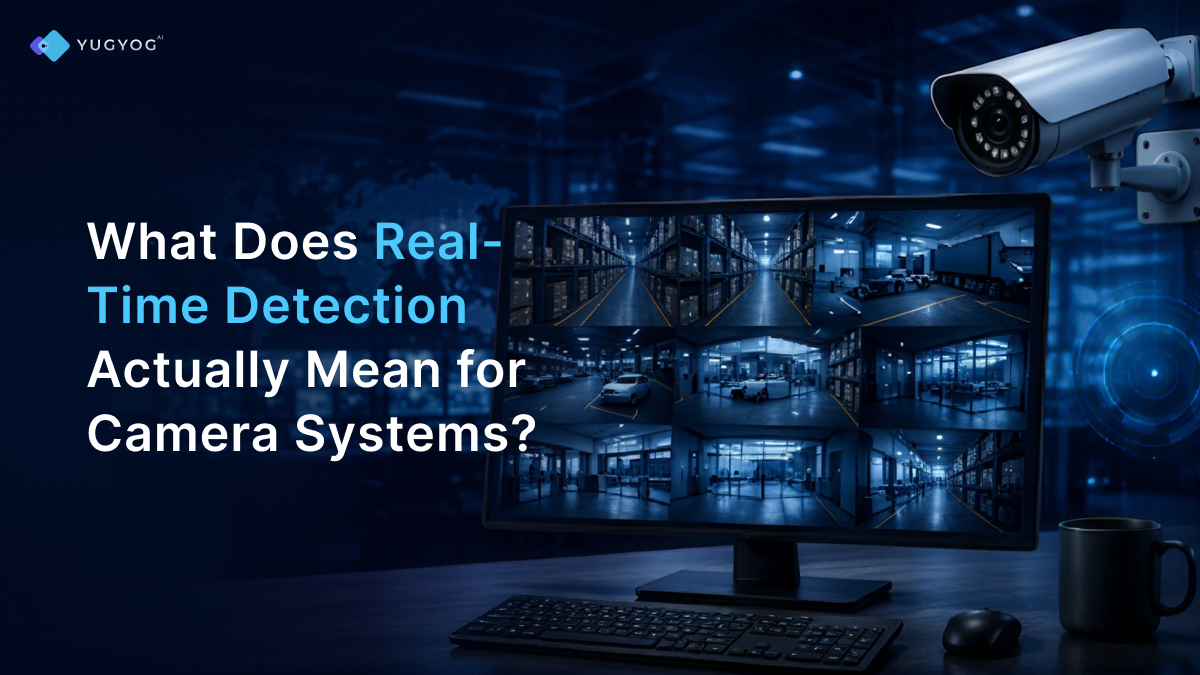
Most organisations believe installing more cameras automatically improves security.
It doesn't. A warehouse may have 300 cameras. A manufacturing plant may have 800. A city surveillance project may operate thousands. Yet incidents still go unnoticed not because cameras failed to record them, but because nobody was watching the right screen at the right moment.
This is the difference between recording and real-time detection.
Traditional surveillance cameras capture events passively. Intelligent video systems identify important events as they happen, allowing organisations to respond immediately instead of reviewing footage hours later.
If you're new to video intelligence, start with YugYog's guide to AI Video Analytics .
Recording Is Not the Same as Detecting
Conventional CCTV systems continuously record video. They faithfully capture everything within a camera's field of view, but recording alone doesn't create awareness.
Imagine these situations:
- Someone enters a restricted electrical room.
- A delivery vehicle blocks a fire lane.
- Smoke begins appearing inside a warehouse.
- An employee enters a hazardous area without PPE.
- A patient falls in a hospital corridor.
A traditional camera records every one of these incidents. But unless someone is actively watching that specific feed, the organisation only discovers the event afterwards.
Real-time detection changes that sequence by continuously analysing live video and notifying the right people the moment something important happens.
For a deeper comparison, read Traditional CCTV vs AI Surveillance .
What Is Real-Time Detection?
Real-time detection in camera systems continuously analyses live CCTV feeds using computer vision to identify predefined events and trigger immediate alerts.
Rather than functioning as a passive recorder, a video intelligence platform actively monitors every connected camera and can:
- Detect security incidents
- Identify safety risks
- Recognise operational events
- Generate immediate alerts
- Create searchable incident records
The objective isn't simply speed it's reducing the time between an incident occurring and the organisation becoming aware of it.
How Real-Time Detection Works
Step 1: Live Video Is Captured
Your existing IP cameras, CCTV systems, DVRs, NVRs and RTSP streams continue capturing footage exactly as they do today. No camera replacement is required.
YugYog's Camera Integration platform supports existing infrastructure across multiple camera manufacturers.
Step 2: Every Frame Is Analysed
Instead of storing footage for later review, the platform analyses each frame as it arrives.
It can identify:
- People and vehicles
- Bags and equipment
- Safety helmets and PPE
- Fire and smoke
This transforms raw video into structured, actionable information.
Step 3: Context Is Understood
Movement alone isn't meaningful.
A person walking into reception during office hours is expected. The same person entering a restricted warehouse at midnight may indicate an intrusion.
The system evaluates context including:
- Object type
- Direction of movement
- Virtual zones
- Time of day
- Duration
- Interaction with other objects
This significantly reduces false alarms compared with traditional motion detection.
Step 4: An Event Is Created
Once an important activity is recognised, the platform instantly creates an event and can trigger:
- Live notifications
- Security alerts
- Incident timelines
- Video bookmarks
- Investigation workflows
YugYog's Event Intelligence and Alerts modules centralise these events into a single operational dashboard.
Where Real-Time Detection Creates Value
Manufacturing
Manufacturing facilities generate thousands of routine activities every day. Rather than manually supervising every camera, teams can automatically detect:
- PPE compliance violations
- Restricted-area access
- Vehicle movement
- Worker presence
- Safety hazards
This improves both workplace safety and operational visibility.
Explore YugYog's Manufacturing Solutions .
Warehousing & Logistics
Distribution centres depend on efficient movement. Real-time detection helps monitor loading dock activity, vehicle arrivals, equipment movement, congestion and restricted zones.
Supervisors receive live visibility instead of discovering delays through recorded footage.
Healthcare
Hospitals prioritise patient safety above everything else. Video intelligence can assist by detecting patient falls, corridor congestion and restricted clinical area access.
The technology supports clinical teams by improving awareness it doesn't replace human judgement.
Learn more about YugYog's Healthcare Solutions .
Retail
Retail operations benefit from both security and customer experience insights.
Common applications include:
- Queue monitoring
- Occupancy awareness
- Stockroom access
- Visitor flow analysis
- Incident investigation
Video becomes an operational tool rather than simply a security asset.
Why Response Time Matters?
The key difference between traditional CCTV and real-time detection is awareness rather than recording quality. While traditional CCTV relies on manual discovery and later review, real-time detection systems instantly identify incidents and trigger automatic alerts, allowing organizations to reduce response times without needing to continuously monitor live feeds.
Why the Industry Is Moving Towards Intelligent Detection?
The global video surveillance market is projected to reach US$80–95 billion in 2026, with intelligent software becoming the fastest-growing segment of the industry, according to Grand View Research .
Meanwhile, the AI video analytics market is expected to grow at 15–30% annually, driven by demand for automation, workplace safety and operational intelligence, according to Fortune Business Insights .The shift isn't about installing more cameras. It's about extracting more value from the cameras organisations already own.
How YugYog Helps
YugYog works alongside existing CCTV infrastructure to transform recorded video into actionable operational intelligence.
Instead of constantly monitoring live feeds, organisations can:
-
Detect incidents in real time
-
Receive intelligent alerts
-
Search footage using natural language
-
Build automatic investigation timelines
-
Monitor compliance across multiple locations
Explore YugYog's AI Video Engine , Forensic Search , or the complete YugYog Platform to see how intelligent video monitoring works.