Loitering Detection vs Line Crossing vs Intrusion Detection
Compare loitering, line crossing and intrusion detection to build smarter CCTV monitoring with intelligent video analytics.
Modern security teams don't just need cameras they need cameras that understand when something unusual is happening.
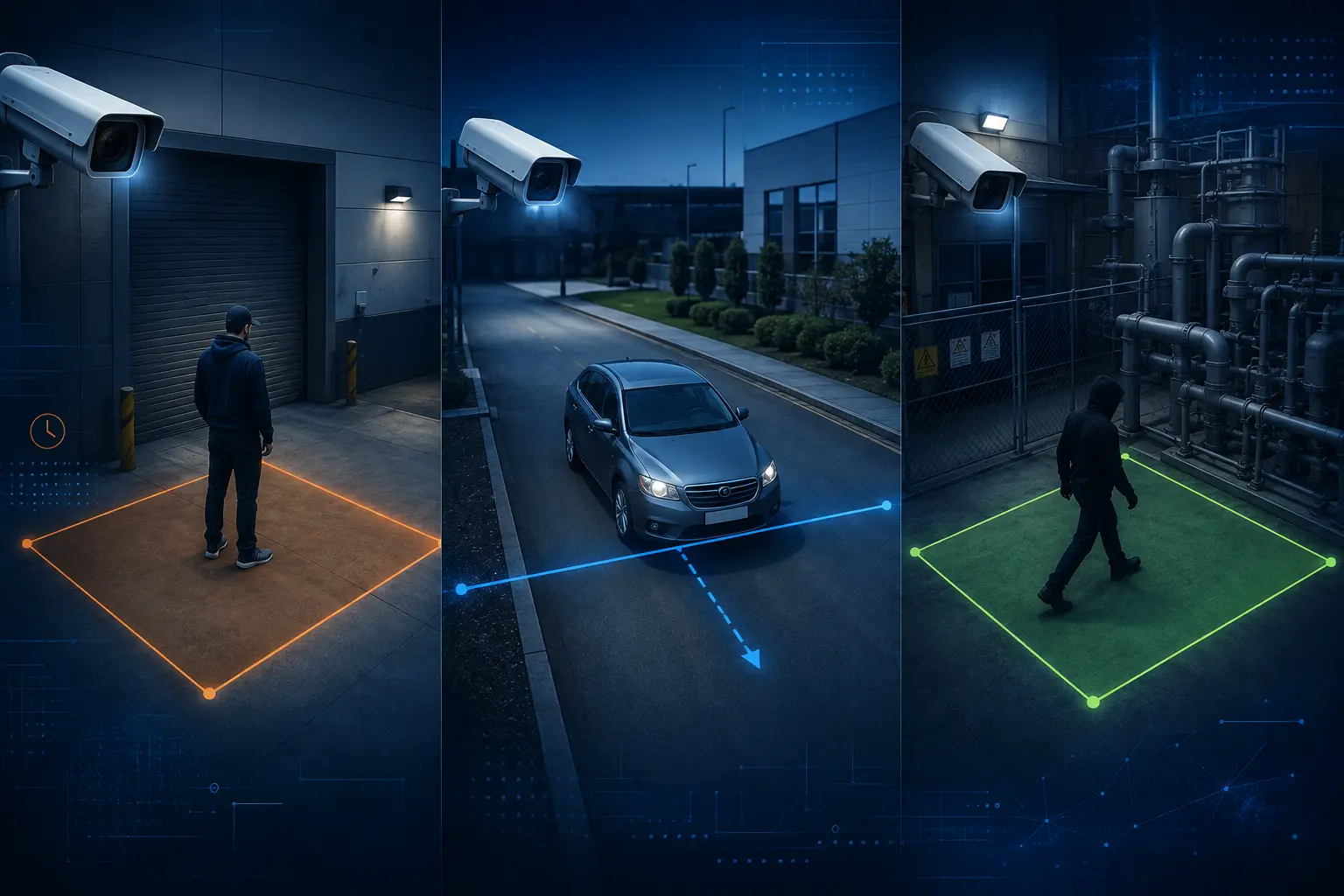
A person walking across a car park during office hours is perfectly normal. The same person standing outside a restricted entrance for twenty minutes, crossing into a secure zone, or entering a prohibited area after business hours may require immediate attention.
These are three different scenarios, and each requires a different type of detection. Understanding when to use loitering detection, line crossing detection, and intrusion detection helps organisations build a far more effective monitoring strategy than relying on motion alerts alone.
If you're new to intelligent surveillance, YugYog's guide to AI Video Analytics explains the foundations behind these capabilities.
Why Motion Detection Isn't Enough
Most traditional CCTV systems rely on motion detection. While it identifies that something has moved, it doesn't understand what happened or whether it matters.
|
Detects any movement |
Understands people, vehicles and objects |
|
Cannot identify intent |
Evaluates context and behaviour |
|
Frequent false alerts |
Event-based notifications |
|
Requires manual review |
Creates actionable incidents |
Imagine a warehouse loading bay. An employee walking through during business hours is expected. A stranger waiting beside the loading dock for fifteen minutes after closing time is a completely different event.
This is where video intelligence adds context, allowing security teams to focus on meaningful activity instead of reviewing hundreds of unnecessary alerts. The difference becomes even clearer when comparing Traditional CCTV vs AI Surveillance .
Understanding the Three Detection Types
Before diving into each feature, here's the simplest way to think about them.
|
Loitering Detection |
Someone stays too long |
Suspicious presence |
|
Line Crossing Detection |
Someone crosses a virtual boundary |
Perimeter monitoring |
|
Intrusion Detection |
Someone enters a protected zone |
Restricted access |
Although these capabilities often work together, they answer three different operational questions.
What Is Loitering Detection?
Loitering detection identifies individuals who remain within a defined area longer than an acceptable period.
The objective isn't to detect movement it's to detect prolonged presence.
The platform continuously tracks people within a designated zone and measures how long they remain there. If the configured duration is exceeded, an event is generated automatically.
Common Use Cases
|
Manufacturing |
Standing near hazardous machinery |
|
Warehousing |
Waiting beside loading docks after hours |
|
Retail |
Lingering near stockrooms or exits |
|
Corporate |
Remaining in reception beyond visitor duration |
|
Education |
Staying near campus entry gates |
Loitering doesn't automatically indicate malicious behaviour, but prolonged presence in sensitive areas is often an early warning sign that deserves attention.
What Is Line Crossing Detection?
Line crossing detection monitors movement across an invisible digital boundary.
Instead of installing physical sensors, organisations create virtual lines directly within the camera view. Whenever a person or vehicle crosses that boundary according to predefined rules, the system records an event.
Where It's Most Effective
- Warehouse vehicle entrances
- Manufacturing production areas
- Campus access points
- Parking facilities
- Construction site boundaries
YugYog's Camera Integration works with existing IP cameras, DVRs and NVRs, allowing organisations to configure virtual boundaries without replacing hardware.
What Is Intrusion Detection?
Intrusion detection identifies unauthorised entry into predefined protected areas. Unlike line crossing, which focuses on movement across a boundary, intrusion detection determines whether someone has entered a location where they should not be present.
Typical Applications
|
Electrical rooms |
Prevent unauthorised access |
|
Chemical storage |
Protect hazardous zones |
|
Data centres |
Secure sensitive infrastructure |
|
Hospitals |
Restrict pharmacy access |
|
Government buildings |
Monitor protected facilities |
When combined with Event Intelligence , every intrusion becomes part of a searchable operational timeline instead of an isolated alert.
A Real Warehouse Scenario
The easiest way to understand these detections is to follow a single incident.
|
What Happens |
Detection Triggered |
|
A person waits near the loading dock |
Loitering Detection |
|
The person crosses the warehouse perimeter |
Line Crossing Detection |
|
The person enters restricted storage |
Intrusion Detection |
Three different detections. One continuous operational story.
When Should You Use Which One?
Choosing the right detection depends on the operational objective rather than the camera itself.
|
Your Goal |
Recommended Detection |
|
Identify suspicious waiting |
Loitering Detection |
|
Monitor entry or exit points |
Line Crossing Detection |
|
Protect restricted rooms |
Intrusion Detection |
|
Secure warehouse perimeters |
Line Crossing + Intrusion |
|
Monitor loading docks |
Loitering + Line Crossing |
In practice, most organisations combine multiple detection types to improve situational awareness across a site.
Beyond Security: Industry Applications
These capabilities improve operational visibility across multiple industries, not just perimeter security.
|
Manufacturing |
Detect restricted-area access and improve workplace safety |
|
Warehousing |
Monitor loading operations and vehicle movement |
|
Healthcare |
Protect controlled departments and emergency exits |
|
Retail |
Secure stockrooms and high-value merchandise |
|
Education |
Improve campus boundary monitoring and visitor awareness |
Related industry solutions:
- Manufacturing
- Warehouse
- Healthcare
- Retail
Reducing Alert Fatigue
One of the biggest challenges in CCTV monitoring is receiving too many alerts.
Traditional motion detection notifies teams every time movement occurs even when it's irrelevant. Intelligent event detection focuses on operational scenarios instead.
|
Employee walks through corridor |
Person remains in a restricted zone for 10+ minutes |
|
Vehicle enters car park |
Vehicle enters warehouse after business hours |
|
Tree moves in the wind |
Individual crosses an exit line in the wrong direction |
|
General movement |
Unauthorised entry into a protected area |
The result is fewer unnecessary notifications and more meaningful alerts.
Why Intelligent Event Detection Is Growing
As camera networks continue to expand, manually monitoring every video feed becomes increasingly impractical.
Industry research shows that software-led video analytics is becoming one of the fastest-growing segments within physical security, driven by demand for automated incident detection, workplace safety and operational visibility. Analysts at MarketsandMarkets and Omdia also highlight the industry's shift towards software and analytics that maximise the value of existing CCTV infrastructure rather than replacing hardware.
The future of surveillance isn't about recording more footage, it's about understanding what cameras observe.
How YugYog Fits
YugYog transforms existing CCTV infrastructure into a video intelligence platform capable of monitoring meaningful operational and security events in real time.
Instead of constantly watching live feeds, organisations can:
- Detect loitering, line crossing and intrusion events
- Receive intelligent alerts instantly
- Search footage using natural language
- Build automatic investigation timelines
- Monitor compliance across multiple locations
These capabilities sit within the broader YugYog Platform , helping organisations centralise monitoring without replacing their existing camera network.
YugYog's AI Video Engine and Forensic Search work together to transform existing cameras into intelligent operational monitoring.