Fire Detection: How Smart CCTV Cameras Detect Fires in Real Time
Discover how AI fire detection transforms your existing CCTV cameras into real-time safety systems. Learn the difference between smoke and flame detection.
1. Introduction: The Critical Window of Fire Response
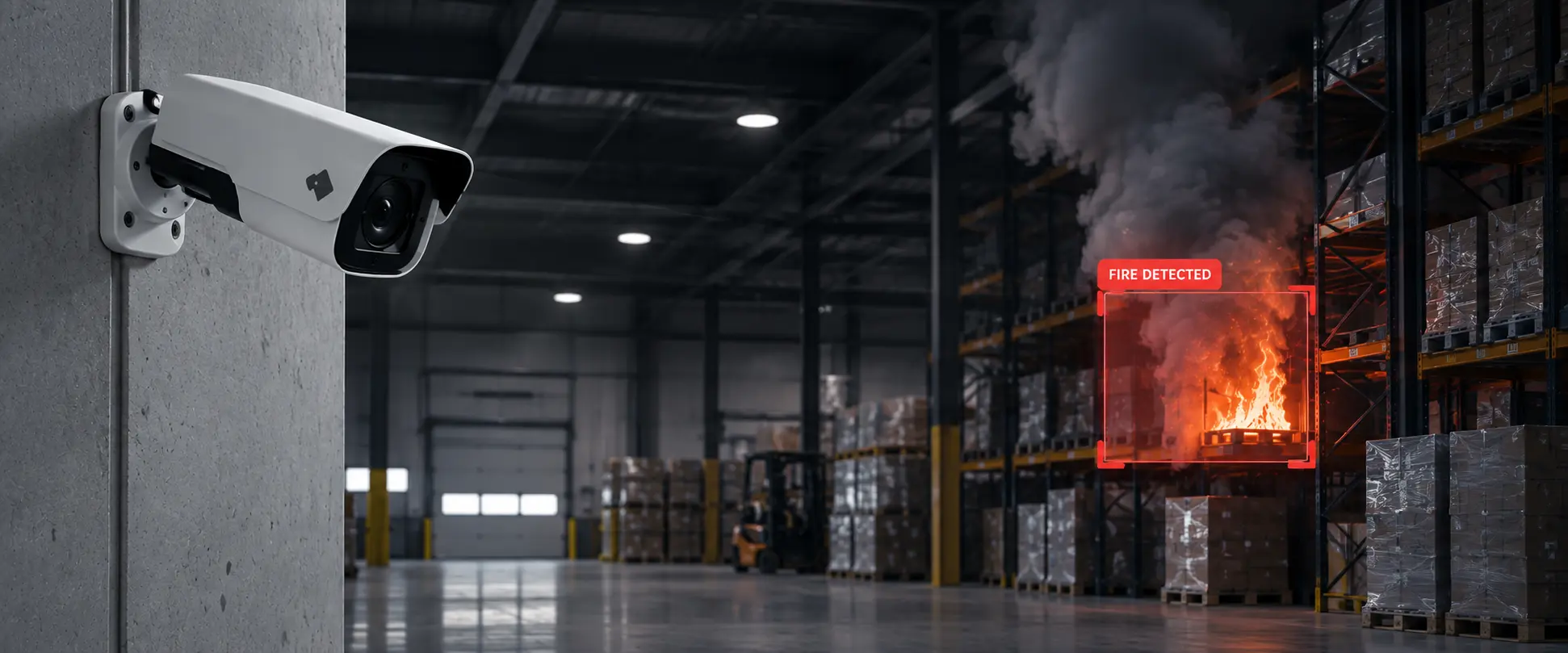
A warehouse fire can double in size every minute. In industrial and commercial settings, the difference between a 20-second alert and a 3-minute delay can determine whether an incident becomes a safely contained event or a catastrophic operational loss. Traditional safety infrastructure has long relied on physical sensors, but these systems often require smoke to physically reach a ceiling-mounted unit before an alarm is triggered.
Today, facilities are leveraging the existing CCTV infrastructure already mounted on their walls and ceilings. By integrating advanced AI video analytics, standard security cameras are transformed into proactive, real-time fire detection systems. This shift from reactive physical sensors to proactive visual intelligence is redefining industrial safety standards.
2. What Is AI Fire Detection?
AI fire detection is a computer vision technology that continuously analyses live video feeds from standard CCTV cameras to visually identify smoke and flames the moment they appear, triggering instant alerts before physical sensors can react.
At its core, this technology uses deep learning algorithms trained on millions of images of fire, smoke, and industrial environments. Unlike traditional physical sensors that measure heat or particle density in the air, AI fire detection uses visual data. Because it relies on sight rather than physical contact with smoke or heat, the system can detect a fire at its source even from hundreds of feet away.
3. Can AI Fire Detection Work with Existing CCTV Cameras?
The most common question facility managers ask is whether they need to rip and replace their current camera network. The short answer is no. A robust AI fire detection system is designed to integrate seamlessly with the hardware you already own.
- IP Cameras and ONVIF: Modern AI platforms use standard ONVIF protocols to pull video streams directly from your existing IP cameras, regardless of the manufacturer.
- Analogue Cameras: Even older analogue cameras can be utilised by passing the feed through a digital encoder before routing it to the camera integration layer.
- Edge vs. Server Deployment: Depending on your bandwidth and security needs, the AI processing can occur on local on-premise servers (for zero latency and high security) or via secure cloud architectures.
- Minimum Resolution: Most AI models require standard high-definition (1080p) feeds to accurately detect the subtle pixel changes associated with early smoke formation.
4. The Fire Response Timeline: AI vs Traditional Systems
Understanding the speed of visual detection requires looking at the actual timeline of a fire breaking out on a facility floor.
|
Fire Development Phase |
Traditional Ceiling Sensor |
AI Video Detection |
|
Initial Smouldering |
Smouldering begins at floor level. |
✅ AI detects visual smoke plume expanding. |
|
Smoke Plume Rises |
Smoke rises but is far from the ceiling. |
✅ System sends instant video alert to dashboard. |
|
Open Flames Erupt |
First open flames appear. |
🚨 Security team verifies video and dispatches response. |
|
Ceiling Level Reached |
Smoke finally reaches the 30ft ceiling. |
Fire extinguisher deployed by staff. |
|
Fire Development Phase |
🚨 Physical alarm triggers. |
Fire is already contained. |
This illustrates why real-time detection is a fundamental upgrade, particularly in large environments.
5. How AI Fire Detection Works
Understanding the mechanics of computer vision clarifies why it is so effective for life safety. Powered by systems like the YugYog AI Video Engine, the process involves several continuous stages of analysis:
- Continuous Capture: Existing cameras continuously capture high-definition video of the monitored environment.
- Frame-by-Frame Analysis: The neural networks scan every individual frame for visual anomalies, actively seeking the specific colour, flickering frequency, or expanding nature of smoke.
- Confidence Scoring: When a potential hazard is spotted, the AI assigns a confidence score based on environmental context.
- Instant Alert Generation: If the score breaches a predefined threshold, the system triggers an alert via your configured alert workflows.
- Dashboard Logging: The event is logged on a central event intelligence dashboard with a bounding box and a short video clip for immediate human verification.
6. Smoke Detection vs Flame Detection
While often grouped together, smoke and flame detection rely on entirely different visual algorithms. Distinguishing between the two is vital for tailoring safety systems to specific industrial environments.
Smoke Detection
Smoke algorithms evaluate the opacity, expansion rate, and direction of a visual anomaly. They are trained to detect white, black, slow-moving, and dense smoke before open flames become prominent.
Best suited for:
- Warehouses: Where smouldering cardboard or pallets produce thick smoke long before flames appear.
- Electrical Rooms: Where overheating wires generate smoke before ignition.
Flame Detection
Flame algorithms focus strictly on the visual characteristics of fire. The AI recognises flame colour, flickering frequency, irregular edge shapes, and rapid growth patterns.
Best suited for:
- Manufacturing: Where combustible materials might ignite suddenly without a prolonged smouldering phase.
- Fuel Storage: Areas requiring instantaneous detection of sparks or open flames.
7. Why AI Reduces False Alarms
A common challenge with traditional industrial fire alarms is the frequency of false positives. Here is exactly how advanced AI models differentiate real threats from standard operational environments:
|
Visual Disturbance |
System Response |
Why AI Ignores It |
|
Welding sparks |
✅ Ignored |
Recognises short lifespan, different flicker behaviour, and downward trajectory. |
|
Steam from machinery |
✅ Ignored |
Calculates a different opacity, rapid dispersion rate, and lack of particulate density. |
|
Vehicle headlights |
✅ Ignored |
Detects linear movement and consistent beam geometry, completely lacking chaotic growth. |
|
Real flame |
🚨 Detected |
Identifies specific colour spectrum, edge flickering, and continuous volume expansion. |
8. Where Should Fire Detection Cameras Be Installed?
Deploying this technology effectively requires strategic camera placement. The technology is highly effective, but it relies on clear lines of sight.
|
Location |
Priority Level |
Reason for Placement |
|
Storage Racks |
High |
High-density areas where fires can climb quickly, bypassing standard sensors. |
|
Battery Rooms |
High |
Lithium-ion storage areas where thermal runaway can occur in seconds. |
|
Electrical Panels |
High |
High-risk zones for short circuits and electrical smouldering. |
|
Loading Docks |
High |
Areas mixing heavy vehicles, fuel, and combustible packaging materials. |
|
Office Corridors |
Medium |
General safety zones that benefit from visual verification during evacuations. |
9. Thermal Cameras vs AI Fire Detection
A frequent question for safety directors is whether to invest in thermal imaging or AI-enhanced standard (RGB) cameras.
|
Feature |
Standard AI Camera |
Thermal Camera |
|
Primary Target |
Visible smoke and flames |
Invisible heat signatures |
|
Hardware Costs |
Lower cost; uses existing infrastructure |
Higher cost; requires specialized hardware |
|
Verification |
Visual verification for human review |
Temperature mapping |
|
Best Use Case |
Broad-area facility monitoring |
Checking internal machinery temperatures |
10. Enterprise Integration & Industries
A fire detection system is only as good as its ability to communicate. By integrating seamlessly with your broader platform architecture, AI detection does not just flag a video feed it interfaces with VMS systems, triggers physical fire alarms, and dispatches automated SMS or email alerts.
This capability is transforming safety outcomes across key sectors:
- Healthcare & Education: Ensuring public safety across expansive campuses by providing instant visual verification to avoid unnecessary and dangerous mass evacuations.
- Retail & Hospitality: Monitoring large public areas discreetly without installing highly visible, intrusive industrial sensors.
- Corporate & Government: Protecting critical infrastructure and sensitive document storage with zero-latency response protocols.
11. Buyer Checklist: Choosing an AI Fire Detection System
If you are evaluating AI surveillance platforms to upgrade your facility's safety, use this criteria matrix to ensure you choose an enterprise-grade solution:
- Existing CCTV Compatibility: Does the system support standard ONVIF and RTSP protocols?
- Dual Detection: Can the models accurately detect both smoke and open flames?
- Real-Time Alerts: Does it support customisable, multi-channel alerts (Dashboard, SMS, Email)?
- Forensic Capability: Does it offer forensic search to easily review historical event logs and video evidence?
- Enterprise Security: Are the data pipelines and edge devices backed by robust platform security standards?