How to Search 30 Days of CCTV Footage Without Watching It
Learn how AI forensic search helps security teams find people, objects and events across days of CCTV footage without manual review.
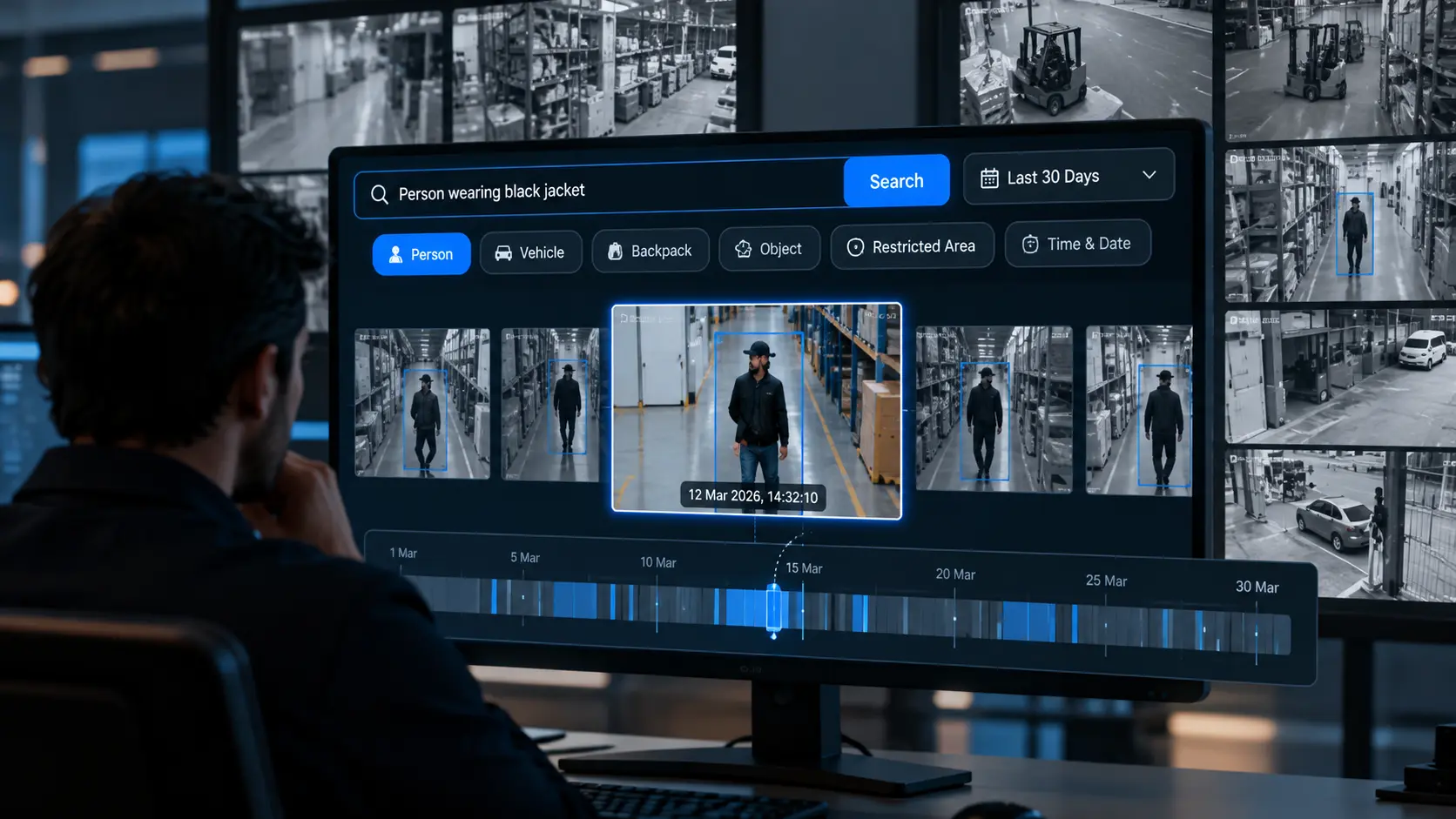
Imagine a security incident happened three days ago. You know roughly where it happened. You may even know the approximate time.But there are dozens of cameras. And each camera has hours of recorded footage. The traditional approach is simple: open the recordings, choose a camera, select a time range and start watching. Then repeat for a large camera network, finding one person, vehicle or event can quickly turn into hours of manual video review.
AI forensic search changes the question from “Which footage should I watch?” to “What exactly am I looking for?”
Instead of manually scrubbing through recordings, security teams can search video using relevant visual and event-based criteria and quickly narrow down the footage that needs investigation.
What Is AI Forensic Search?
AI forensic search is a way of searching recorded CCTV footage using visual information and structured video events rather than relying only on timestamps and camera numbers.
Traditional CCTV search typically starts with:
Camera → Date → Time → Manual review
AI-assisted forensic search adds another layer:
What happened? → Search → Relevant footage → Investigation
This is particularly useful when the exact time or camera is unknown.
For example, instead of checking every camera between 2:00 PM and 5:00 PM, a security investigator may need to find:
- A person entering a particular area
- A vehicle appearing in a location
- An object or activity captured by a camera
- A previously detected security event
- Footage associated with a particular incident
The purpose is not to eliminate investigation. It is to make the investigation far more targeted.
How Can You Search 30 Days of CCTV Footage?
AI forensic search allows security teams to narrow large volumes of recorded CCTV by searching for relevant people, objects, events or visual conditions instead of manually watching every recording. The system helps identify potentially relevant footage so investigators can focus on the clips that matter.
Why Searching CCTV Manually Becomes a Problem
CCTV is excellent at creating a record of what happened. The problem starts when someone asks a question about that record. Consider a warehouse with 50 cameras. An incident occurs sometime during a three-day period.
The security team now needs to determine:
- Which camera captured it?
- At what time?
- Which direction was the person moving?
- Was a vehicle involved?
- Did the person enter a restricted area?
- What happened immediately before and after?
With conventional search, investigators may have to check multiple camera feeds and repeatedly adjust timestamps. The footage exists.
Finding the right footage is the difficult part.
This is why the distinction between recording and searchable video intelligence matters.
How AI Forensic Search Works
The exact workflow depends on the platform and deployment, but the basic idea is straightforward.
Step 1 CCTV Captures the Scene
Existing cameras continue capturing video across the organisation's premises.
This could include:
- Warehouses
- Manufacturing floors
- Retail locations
- Corporate buildings
- Healthcare facilities
- Educational campuses
- Government facilities
YugYog is designed to work with supported existing camera infrastructure, allowing organisations to add intelligence to their camera environment through camera integration.
Step 2 Video Becomes Searchable Information
Instead of treating recorded video as one continuous stream, video analytics can identify relevant visual information and events.
This creates a more structured way to work with recorded footage.
That distinction is important.
A traditional recording might tell you:
Camera 18 recorded footage from 10:00 AM to 11:00 AM.
An intelligent video system can help answer:
Which footage contains the event I'm investigating?
YugYog's AI Video Engine provides the underlying video intelligence layer for supported detection and analysis.
Step 3 The Investigator Defines What They Need
The investigator starts with the incident rather than the recording.
For example:
“I need to find the footage where a person entered the restricted area.”
Or:
“Show me the relevant footage around this security event.”
The more specific the investigation, the easier it becomes to narrow down relevant footage.
Step 4 Relevant Footage Can Be Investigated
Once relevant results or events are identified, investigators can focus on those parts of the recording instead of watching hours of unrelated footage.
This is where Forensic Search becomes particularly valuable.
The objective is simple:
Spend less time finding the footage. Spend more time understanding what happened.
What Can You Search For in CCTV Footage?
The answer depends on the capabilities of the specific video analytics system and how cameras are configured.
For YugYog, forensic investigation can work alongside detected events and video intelligence across the camera environment.
Common investigation questions can include:
|
Investigation Question |
What the Search Helps With |
|
Who or what appeared in an area? |
Narrowing relevant footage |
|
Where did an event happen? |
Identifying relevant camera views |
|
When did the event occur? |
Narrowing the investigation window |
|
Did a restricted-area event occur? |
Reviewing configured intrusion events |
|
Was there a line-crossing event? |
Investigating boundary crossings |
|
Was a fall detected? |
Reviewing fall-related events |
|
Was fire or smoke detected? |
Investigating fire/smoke events |
|
What happened around an event? |
Reviewing surrounding footage |
The important point is that forensic search works best when paired with event intelligence rather than treated as a simple video player.
AI Forensic Search vs Traditional CCTV Search
|
Manually review footage |
Narrow down relevant footage |
|
Heavy reliance on operators |
Uses video intelligence to assist investigation |
|
Search can become time-consuming |
Designed to reduce unnecessary review |
|
Events can remain buried in recordings |
Detected events can provide investigation context |
|
Primarily time-based |
Can be event and visual context-based |
Traditional CCTV still has its place.
If you know the exact camera and timestamp, manually opening the recording may be perfectly adequate.
The problem is when you don't know exactly where to look.
What If You Don't Know Which Camera Captured the Incident?
This is one of the most useful scenarios for forensic search. Suppose an incident happened somewhere inside a warehouse, but the person reporting it cannot identify the camera.
With conventional CCTV, investigators may need to check camera after camera.
With an intelligent video environment, detected events and searchable information can help narrow the investigation to the cameras and time periods that are actually relevant.
This is especially useful across facilities with large camera networks.
The system doesn't replace the investigator's judgement. It helps reduce the amount of irrelevant footage they have to inspect.
AI Forensic Search and Event Intelligence
Forensic search becomes even more useful when combined with structured event information. For example, an organisation may already have an event indicating that a person entered a configured restricted area.
Instead of beginning with hours of raw video, the investigator can begin with the event.
YugYog's Event Intelligence is designed to turn camera observations into structured events that teams can work with.
This creates a useful investigation workflow:
Detection → Event → Search → Evidence → Investigation
The camera captures the scene. The system identifies a configured event. The event provides context.
Forensic search helps investigators locate relevant footage.
The investigator then reviews the evidence and determines what happened.
A Real-World Example: Investigating a Warehouse Incident
Imagine a warehouse reports that an unknown person entered a restricted storage area during the night.
The security team knows only three things:
- The incident happened overnight.
- It involved a person.
- The restricted storage area was involved.
With conventional CCTV, the team might start reviewing recordings from the relevant cameras across the entire night.
With an intelligent video system, the investigation can begin with the restricted-area event.
The team can then:
- Identify the relevant event.
- Locate the associated camera footage.
- Review what happened before the event.
- Review what happened after the event.
- Investigate the surrounding footage.
- Record the findings.
The difference is not that the system magically solves the investigation.
The difference is where the investigation starts.
Instead of starting with hours of video, it starts with a relevant event.
Can AI Forensic Search Work With Existing CCTV?
It can, depending on the camera and deployment environment.
Replacing an entire CCTV network is not always practical, particularly for large organisations with cameras already installed across multiple facilities.
YugYog's camera integration capabilities are designed to connect supported camera environments, allowing organisations to build intelligence on top of existing infrastructure.
This means the transition can focus on making existing video more useful rather than simply adding more cameras.
Where Is AI Forensic Search Most Useful?
Forensic search can be useful anywhere organisations need to investigate large amounts of recorded video.
Manufacturing
Manufacturing facilities may need to investigate incidents around production areas, restricted zones, machinery and employee access points.
YugYog provides a dedicated manufacturing solution for organisations looking to add video intelligence to their operations.
Warehousing and Logistics
Warehouses can have large camera networks covering loading docks, storage aisles, entrances and vehicle movement.
When an incident occurs, quickly narrowing down relevant footage can save significant investigation time.
See how YugYog approaches warehouse video intelligence.
Retail
Retail teams may need to investigate incidents involving store entrances, checkout areas, restricted spaces or customer activity.
A searchable video environment can help teams move from a general time window to more relevant footage.
YugYog also provides a dedicated retail solution.
Healthcare
Hospitals and healthcare facilities have cameras across entrances, corridors and controlled areas.
When an incident needs investigation, being able to narrow down relevant footage can make the process more manageable.
Forensic Search Is Not Just About Finding a Person
A common misconception is that forensic video search is simply about finding a specific person.
In practice, investigations can involve much more.
The question might be:
- What happened?
- Where did it happen?
- When did it happen?
- Which camera captured it?
- What happened immediately before?
- What happened immediately afterwards?
- Was there a related security event?
This is why context matters as much as search.
A useful forensic system should help investigators build a picture of an incident rather than simply return a single frame.
What Makes AI Forensic Search Different From a Video Player?
A video player answers:
“What was recorded at this time?”
Forensic search aims to answer:
“Where is the footage relevant to my investigation?”
That is a fundamental difference.
The first is playback.
The second is investigation.
For organisations with large amounts of CCTV footage, this distinction can become increasingly important as camera networks grow.
What Happens After You Find the Footage?
Finding the relevant footage is only the first step.
Security teams may need to:
- Review the surrounding context
- Identify related events
- Document what happened
- Share findings with authorised teams
- Investigate whether similar events occurred
- Maintain an appropriate record of the incident
YugYog combines Forensic Search with event intelligence, alerts and its wider video analytics platform to support this broader workflow.
For organisations with stricter security requirements, YugYog also provides a dedicated security architecture covering features such as tamper-evident event records and access controls.
Does AI Forensic Search Replace Security Investigators?
No.
It is better understood as an investigation tool.
Security teams still decide:
- What happened
- Whether an event is significant
- What action should be taken
- Whether additional investigation is required
- How the incident should be documented
AI can help reduce the amount of footage that needs to be reviewed, but human judgement remains important.
The best outcome is not AI instead of investigators.
It is investigators with better tools.
The Future of CCTV Investigation Is Search, Not Scrubbing
Most organisations already have a large amount of video data.
The challenge is no longer simply capturing more of it.
It is finding meaning inside it.
When an incident happens, security teams should not have to start by watching hours of footage just because the relevant moment is buried somewhere inside it.
AI forensic search provides another way to approach the problem:
Describe the investigation. Find the relevant event or footage. Review the evidence.
That is the shift from CCTV as a recording system to CCTV as a searchable source of operational intelligence.
If your security team is still spending hours manually scrubbing through recordings to find one incident, YugYog's Forensic Search can help turn that footage into something your team can actually search and investigate.
Explore the YugYog Platform to see how video analytics, event intelligence and forensic search work together.